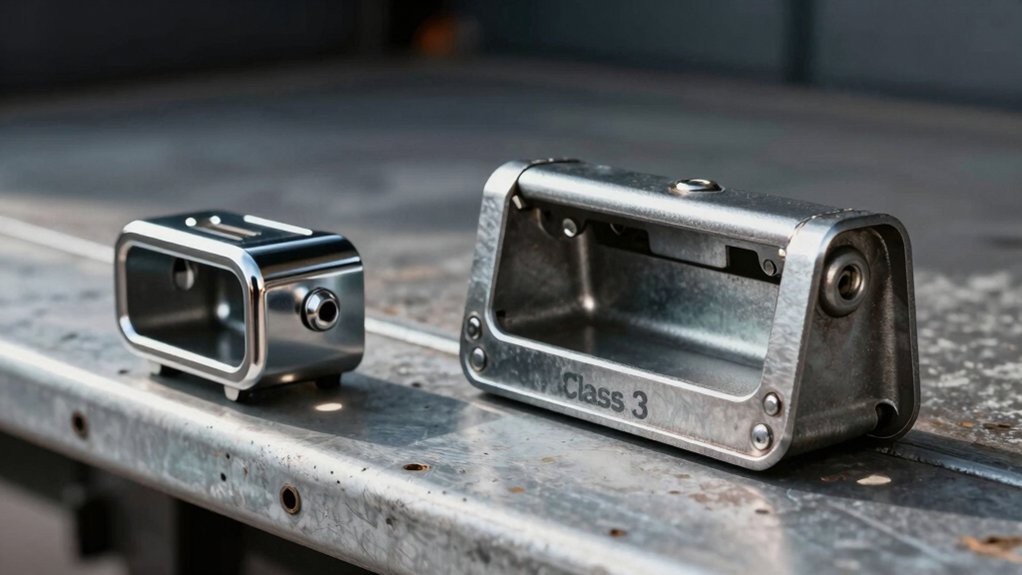
You’ll find five main hitch types: receiver hitches mount to the frame and come in Classes 1‑5, handling 2,000‑20,000 lb GTW with varying tongue weights; bumper hitches bolt to the rear bumper, offering lightweight duty up to 2,000 lb. Fifth‑wheel and gooseneck hitches sit in the truck bed, the former latching a kingpin for 16,000‑30,000 lb loads, the latter using a ball‑and‑coupler for similar capacities and better weight distribution. Pintle hitches use a hook‑and‑ring system for rugged, off‑road or commercial towing up to 60,000 lb. Continue for deeper details on each type’s mounting, class ratings, and best applications.
How to Choose the Right Truck Hitch for Your Vehicle
When you start sizing up a hitch, first check your vehicle’s towing capacity in the owner’s manual and match it to the class ratings: Class 3 (up to 8,000 lb GTW) fits most vans and SUVs with a 2‑inch receiver, Class 4 (up to 10,000 lb) is limited to trucks and SUVs with the same receiver size, Class 5 (up to 20,000 lb) requires a commercial‑duty chassis, and gooseneck or fifth‑wheel setups need a pickup bed. Verify that the trailer weight distribution aligns with the hitch class; Class 3 and 4 allow up to 800 lb and 1,000 lb tongue weight respectively, while Class 5 mandates a weight‑distribution system for stability. Both Class 3 and Class 4 hitches feature a 2-inch receiver tube that provides reliable connectivity for mid-range towing applications. Review hitch installation requirements: Class 4 and 5 often need electric brake controllers, and gooseneck mounts require a bed‑mounted ball. For superior stability and heavy-duty towing applications, consider pintle hitches which can handle loads up to 60,000 lbs for the most demanding tasks. Guarantee the receiver size, bolt pattern, and structural reinforcement meet the manufacturer’s specifications before mounting. Trailer hitch provides a secure connection between the trailer and towing vehicle. Standard receiver tubes come in sizes of 1-1/4″, 2″, 2-1/2″, and 3″, with smaller tubes typically used for light-duty applications and larger tubes for heavy-duty towing.
Receiver Hitch: Versatile, Frame-Mounted Solution
A receiver hitch is a frame‑mounted, square‑tube coupling that lets you insert a wide range of accessories—drawbars, bike racks, cargo carriers—directly into the vehicle’s structural chassis. You’ll find five classes, each defined by tube diameter and gross‑towing‑weight (GTW) rating. Class 1 (1‑1/4″) handles up to 2,000 lb, ideal for small SUVs and trailers under six feet. Class 2 (1‑1/4″) raises GTW to 3,500 lb and tongue‑weight (TW) to 300 lb, suiting minivans and compact crossovers. Classes 3 and 4 use 2″ tubes, supporting 8,000‑12,000 lb GTW and up to 1,400 lb TW for trucks, vans, and full‑size pickups. Class 5 expands to 2‑2.5″ tubes, reaching 20,000 lb GTW for heavy‑duty pickups. Class 3 hitches are particularly popular for their compatibility with weight distribution systems, which can increase towing capacity to 12,000 lbs for enhanced stability. The tongue weight capacity of each class directly impacts how much weight can be placed on the hitch ball without compromising vehicle handling. For superior stability when hauling RVs or livestock trailers, consider gooseneck and fifth-wheel hitches as alternatives to receiver models. During hitch installation, secure the unit to the frame, verify vehicle towing capacity matches the class, and pair it with appropriately rated ball mounts and hitch accessories. Class 4 hitches are also suitable for small trucks.
Bumper Hitch: Simple Light-Duty Attachment
After covering the frame‑mounted receiver hitch’s classes and load ratings, the next option to ponder is the bumper hitch, which attaches directly to the vehicle’s rear bumper with a tow‑ball mount. You’ll find a square receiver tube that mirrors a rear receiver but bolts to the bumper, eliminating frame work. Light‑duty capacity tops out near 2,000 lb gross trailer weight, and tongue‑weight limits follow the bumper’s stamped rating, so you must verify specifications before use. Compatibility spans trucks, SUVs, and some sedans, provided the bumper can support the load. Installation is straightforward and inexpensive, making cost considerations favorable for occasional towing. Space requirements are minimal, as the hitch occupies only the bumper area, but stability diminishes with heavier loads. Bumper hitches also provide a convenient stepping surface for accessing roof racks or cargo, adding practical utility beyond towing capabilities. Bumper hitches suit similar light-duty vehicles as Class 1 receiver hitches, making them a comparable option for small trailers and cargo carriers. To ensure safe towing, always review the load capacity ratings specific to your vehicle model before hitching your trailer. The receiver size for a bumper hitch is typically 1‑1/4 inch, aligning with Class 1 specifications.
Fifth-Wheel Hitch: Heavy-Duty Bed-Mounted Option
You’ll find that a fifth‑wheel hitch offers the most robust, bed‑mounted solution for heavy‑duty towing, anchoring directly over the truck’s rear axle to maximize stability. The jaw system latches the trailer’s kingpin, while a funnel‑shaped head guides alignment and reduces false hookups. Dual‑articulating heads allow 360‑degree nesting, absorbing bumps and improving ride quality. Weight distribution occurs over the rear axle, minimizing sway and enhancing handling. Capacities range from 16,000 lb to 30,000 lb gross towing, with vertical loads of 5,000–6,000 lb. Fixed or sliding models suit different turning radii; sliding units use manual or automatic locks for over‑90‑degree angles. Modern fifth wheel systems are available in specialized options like puck system hitches for OEM-equipped trucks that enable easy installation and removal. Height‑adjustable plates (17–19 in) level the hitch on uneven terrain, and lightweight two‑piece designs keep overall vehicle weight low. All models meet SAE J2638 safety standards. The kingpin locks securely into the hitch’s locking mechanism, which can pivot to accommodate directional changes. This design originated from horse-drawn carriages, evolving into the modern fifth wheel system used for RVs, campers, and semis today. Know Your Truck Bed Length is essential to ensure the hitch clears the tailgate and provides proper clearance for the trailer.
Gooseneck Hitch: High-Capacity Agricultural Choice
While the fifth‑wheel’s bed‑mounted design dominates heavy‑duty towing, the gooseneck hitch offers a high‑capacity, agricultural‑focused alternative. You mount the ball‑and‑coupler assembly directly in the truck bed, positioning the hitch point over the rear axle to improve weight distribution. The curved “goose neck” arch clears the tailgate, leaving cargo space when idle. Rated up to 30,000 lb GTW and compatible with Class V hitches, it surpasses bumper‑pull limits and handles both massive equipment and modest loads. The design reduces trailer sway, enhancing towing stability in crosswinds and on highways. The trailer’s curved coupler slides over the ball and secures via a locking pin, latch, or twist mechanism to handle the heavy vertical tongue weight. Removable or fold‑down models keep the bed tidy, while extensions, high‑rise balls, and inverted‑ball storage adapt reach and clearance for varied farmyard configurations. Proper installation requires securing the hitch assembly to the truck’s frame using brackets and hardware torqued to manufacturer specifications. Investing in gooseneck hitch locks provides essential security against trailer theft and unauthorized use. High towing capacity makes it ideal for hauling livestock and heavy farm equipment.
Pintle Hitch: Rugged Commercial and Off-Road Use
A pintle hitch is a hook‑and‑ring system that latches a vehicle‑mounted pintle hook onto a lunette ring affixed to the trailer, creating a robust pivot point for both vertical and horizontal articulation. You’ll find the primary component on the tow vehicle, while the lunette ring loops over the hook and clamps with a claw‑like latch. This design delivers pintle hitch durability through hardened steel construction and a secure lock that resists vibration and impact. Its pintle hitch versatility lets you handle tongue weights far beyond ball hitches, and the larger target ring simplifies alignment on uneven, off‑road terrain. The flexible ring-and-hook configuration distributes forces more efficiently than traditional ball hitches, reducing downward pressure on the connection. Capacity ranges from 10,000 lb to 60,000 lb, with vertical loads up to 12,000 lb, making it ideal for military, agricultural, and construction applications where rugged performance is essential. Premium options like Diamond C’s PX series and MAXX-D’s LDX pintle flatbeds provide enhanced payload ratings and commercial-grade durability for the toughest hauling jobs. The pintle hitch also provides increased articulation for navigating challenging terrains. A safety pin] secures the connection for added reliability in demanding towing scenarios.
What Hitch Class Do You Need? Capacity Explained?
Pintle hitches excel in rugged, off‑road scenarios, but most everyday towing relies on receiver‑type hitches, which are classified by their weight capacities. When you assess towing capacity considerations, match the class to your vehicle’s Gross Vehicle Weight Rating (GVWR) and the trailer’s Gross Trailer Weight (GTW). Class 1 (1‑1/4″) handles up to 2,000 lb GTW and 200 lb tongue weight, ideal for small cars and light trailers. Class 2 (1‑1/4″) raises the limit to 3,500 lb GTW and 350 lb tongue weight, suiting mid‑size SUVs and small trucks. Class 3 (2″) supports 8,000 lb GTW (some sources 6,000 lb) with 800 lb tongue weight, fitting larger SUVs and trucks. Class 4 (2″) reaches 10,000 lb GTW and 1,000 lb tongue weight for full‑size trucks. Class 5 (2‑1/2″–3″) tops out at 20,000 lb GTW and 2,700 lb tongue weight, designed for commercial vehicles and fifth‑wheel setups. Align these classes with appropriate hitch mounting configurations to guarantee safe, compliant towing. Remember that towing capacity is limited by the vehicle’s Gross Axle Weight Rating (GAWR) as well as its overall Gross Combined Weight Rating (GCWR). Class 2 and Class 3 hitches are commonly constructed from American steel with corrosion-resistant coatings to ensure durability and longevity. Class 3 hitches are particularly versatile for recreational towing activities such as camping, boating, hunting, and motorsports with midsized boats, small campers, utility trailers, ATVs, cargo carriers, or bike racks.