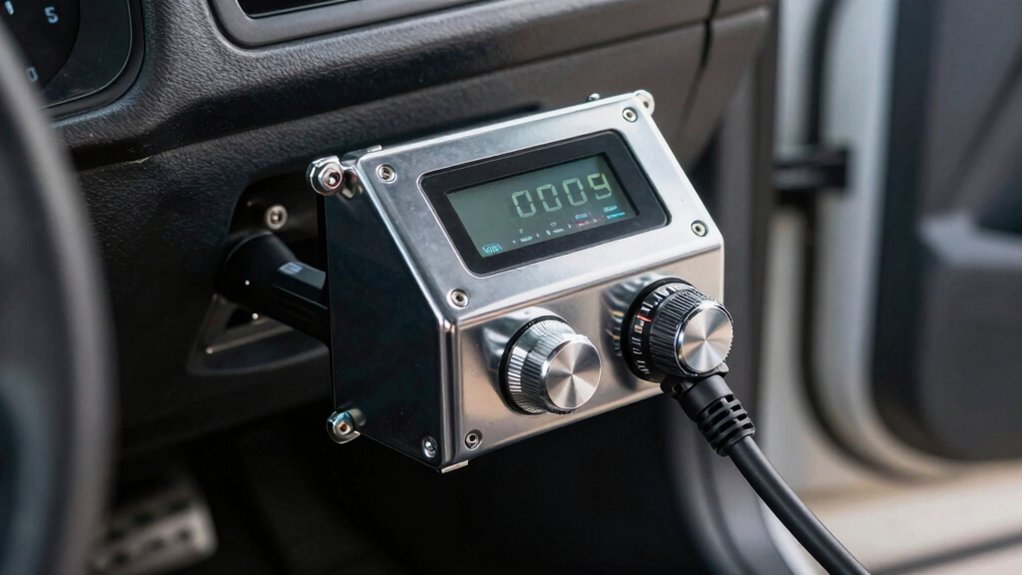
You’re using a trailer brake controller to synchronize your tow vehicle’s brakes with your trailer’s braking system. When you decelerate, accelerometers detect motion changes and send proportional voltage to your trailer’s brake assembly, energizing an electromagnet that presses brake shoes against the drum. This intelligent distribution prevents jackknife accidents and reduces stopping distances significantly. Your controller’s sensor data processes vehicle speed in real-time, adjusting braking force based on momentum and terrain for excellent performance across varied conditions.
Why You Need a Trailer Brake Controller
Because trailers can’t brake independently, you need a trailer brake controller to synchronize braking between your tow vehicle and trailer, creating a unified, controlled deceleration system. This synchronization prevents jackknife accidents by distributing braking force proportionally, eliminating the dangerous scenario where your trailer pushes forward during stops. You’ll reduce stopping distances considerably when hauling heavy loads—critical for emergency situations requiring rapid deceleration. The controller protects your tow vehicle’s brakes from excessive heat and premature wear by sharing the braking burden, extending their lifespan and reducing maintenance costs. Additionally, proper brake distribution improving fuel economy by promoting smoother, more efficient deceleration patterns. Customizable settings allow you to adjust the controller for changing tow weight and varying road conditions to maintain optimal braking performance. Installation options range from mounting under the dashboard to plug-and-play wireless solutions, depending on your vehicle’s compatibility and setup preferences. If your trailer uses electric brakes, a brake controller is essential for proper operation and safety. Many states legally mandate trailer brakes for trailers exceeding 3,000 pounds, making compliance essential for avoiding fines and liability exposure. Modern controllers feature both proportional and time-delayed brake types to match your specific trailer’s braking system and ensure responsive, reliable stopping power in all conditions.
How Proportional Controllers Work
While a time-delayed controller relies on preset braking sequences, a proportional controller uses real-time vehicle dynamics to deliver synchronized stopping power. You’ll benefit from an accelerometer that detects your tow vehicle’s deceleration and converts those inertia changes into electrical signals. This real-time feedback enables your controller to send proportional voltage to trailer brakes independently of pedal pressure, matching your stopping intensity precisely.
Your braking power adjusts continuously based on momentum changes rather than following predetermined ramps. For optimized performance, the system accounts for trailer weight, speed, and terrain conditions automatically. Heavy loads or downhill descents trigger increased power, while light loads or uphill grades receive reduced force. This adaptable approach guarantees smoother, more responsive braking tailored to each unique stopping event. When selecting a proportional controller, you should evaluate compatibility with various trailer types to ensure seamless integration with your specific towing setup. Modern proportional controllers like the REDARC Tow-Pro Elite deliver immediate response without jerking, ensuring professional-grade stopping performance. The brake controller in your towing vehicle translates your braking input into signals that ensure proportional engagement of trailer brakes for enhanced control and stability. Leading aftermarket options like Tekonsha’s Primus IQ feature digital readouts and adjustable brake boost levels for enhanced terrain-adaptive performance.
Time-Delayed Controllers: The Simpler Option
What if you preferred a trailer brake system that operates on simplicity rather than continuous adjustment? Time-delayed controllers offer exactly that—a straightforward braking solution designed for predictable towing patterns. You’ll apply a preset braking force that ramps up gradually over a fixed time period whenever you press your brake pedal. This system doesn’t adapt to your braking intensity; instead, it delivers consistent force regardless of how gently or firmly you brake. The simplified wiring design makes installation less complex than proportional systems, requiring only basic wire connections to your vehicle’s brake pedal switch and battery. You’ll find time-delayed controllers particularly effective for light-duty towing at moderate speeds where preset braking force remains adequate. They’re ideal when you maintain consistent braking habits and prioritize reliability over adaptive responsiveness. Time-delayed controllers work best for compatible trailer types that don’t require the advanced sensing capabilities of proportional systems. For vehicles without integrated brake controllers, wireless solutions like the Tekonsha and Prodigy RF systems offer alternatives that eliminate complex wiring requirements. Time-delayed controllers are simple and effective but do not account for speed or weight variations during different towing conditions.
Proportional vs. Time-Delayed: Which Stops Better
Two fundamentally different control philosophies govern how these systems apply braking force to your trailer. Proportional controllers match your vehicle’s deceleration precisely through accelerometer sensors, delivering smooth, adaptive stopping that automatically adjusts for load weight and speed. Time-delayed systems ramp preset braking power over fixed intervals, initiating braking immediately but without real-time adjustment.
When evaluating stopping performance metrics, proportional systems consistently outperform in varied conditions, producing shorter stops and eliminating surge. Time-delayed units excel in panic situations by applying initial braking faster, though their effectiveness depends heavily on operator tuning. Proportional controllers require in-line mounting with the vehicle’s direction for proper operation. Fine-tuning your proportional controller’s automatic gain setting ensures optimal braking performance without wheel lockup across different load conditions.
Your controller selection factors should include terrain frequency, load variability, and convenience priorities. Trusted brands like Tekonsha, Redarc, and Curt dominate the market due to easy installation and digital diagnostics. Factory brake controllers represent an advanced option that senses brake pedal pressure and applies proportional braking tuned specifically for your vehicle. Proportional offers superior plug-and-play performance across diverse conditions, while time-delayed suits occasional, lighter-duty applications where simplicity and cost matter most.
How Your Brake Assembly Converts Signals to Stops
Your brake controller’s signal means nothing without the assembly that converts it into actual stopping power. When your controller sends voltage through the seven-pole connector, it energizes the electromagnet housed within your brake assembly. This magnetic field pulls the armature plate inward, pressing brake shoes against the drum interior. The friction generated decelerates your trailer wheels proportionally to the signal voltage you’re sending. Maintaining brake shoe condition guarantees consistent friction and reliable stopping force. Proper brake system balance across both sides prevents uneven deceleration and trailer sway. Understanding load capacity compatibility between your controller and trailer ensures safe braking performance under various towing conditions. You can verify your brake controller is functioning correctly by testing the manual slide and brake pedal activation to ensure proper signal output before diagnosing any trailer connection issues. Modern wireless controllers like the Curt Echo offer smartphone app control for convenient brake management while towing. For custom electronic braking systems like those using motor driver translation, the voltage signal must be properly converted to match the actuator’s power requirements. When you release the brake pedal, the electromagnet de-energizes immediately, disengaging the shoes and allowing your wheels to roll freely again.
How Brake Controllers Detect Deceleration
Triggering that electromagnetic response requires the controller to first recognize when your tow vehicle’s slowing down. Your brake controller employs multiple sensor technologies to accomplish this task with precision. Accelerometers detect changes in motion by measuring inertial forces, while gyroscopes capture rotational dynamics during braking events. These sensors convert physical deceleration into electrical signals that the controller interprets.
The deceleration measurement process filters out gravitational effects to guarantee accuracy. Your controller continuously processes this sensor data alongside your vehicle’s speed input, calculating the exact braking force needed for proportional trailer brake activation. This real-time responsiveness allows your system to adapt instantly to varying braking intensities—whether you’re executing gentle stops or emergency maneuvers—without preset delays or fixed power outputs. Signal processing from your sensors ensures that the controller determines the braking force with precision across all driving conditions. Electric brake controllers offer faster response times compared to traditional systems, enabling quicker trailer brake engagement during deceleration events. The gain control on your brake controller determines how much braking power reaches the trailer’s brake magnets based on these calculations. Proper gain adjustment requires test driving at low speeds while manually engaging the brakes to ensure the trailer brakes engage before the truck’s brakes lock.
Anti-Lock Braking in Trailer Controllers
While your trailer brake controller manages proportional braking force, an anti-lock braking system (ABS) operates independently to prevent wheel lockup during severe deceleration. Your ABS monitors wheel rotation speeds multiple times per second, rapidly applying and releasing brakes on individual wheels to maintain rotation and maximize stopping efficiency.
The anti-lock braking performance benefits you enormously during emergency stops on slippery surfaces. By preventing wheel lockup, you maintain steering control and directional stability—critical factors when avoiding hazards. The anti-lock braking advantages extend beyond safety: you’ll experience reduced jackknifing, fishtailing, and trailer swing-out. These capabilities enhance your confidence during avoidance maneuvers while improving tire wear on lightly loaded or empty trailers. For comprehensive protection of your towing setup, consider pairing your brake controller with reliable security measures to safeguard your trailer during stops. Selecting the right brake controller model for your specific towing needs ensures optimal compatibility with your trailer’s braking system. The Trailer Anti-Lock Braking System #2021017577 provides genuine replacement reliability for seamless integration with your existing axles and chassis components.
Dialing In Your Brake Controller’s Sensitivity
Getting the sensitivity right on your brake controller requires methodical testing and adjustment to match your specific trailer and driving conditions. Start with mid-level gain settings between 3.0 and 5.0, then progressively test at various speeds—beginning at 10 mph with manual override, advancing to 25 mph for full brake applications.
Monitor your trailer’s response carefully. If it locks up, decrease gain promptly. If braking feels insufficient, increase sensitivity gradually. Your gain settings optimization depends on load weight, road conditions, and brake wear. Heavier loads demand higher settings; empty trailers require lower ones.
Make multiple adjustments at mid-to-high speeds, observing smooth, firm stops without lockup. This brake controller sensitivity calibration guarantees your trailer matches vehicle deceleration precisely, preventing dangerous sway and assuring consistent stopping performance across varying conditions. If your trailer brakes appear constantly applied even on new equipment, check for proper drag and adjust the trailer brakes if possible to ensure correct operation.
Diagnosing and Fixing Common Controller Issues
Even well-calibrated brake controllers can develop faults that compromise your trailer’s stopping performance. Start by testing trailer wiring continuity using a multimeter to identify shorts or breaks in circuits. Measure resistance between brake wires and ground points to pinpoint electrical faults. Next, check brake magnet resistance with your multimeter—damaged magnets display incorrect readings and require replacement. Inspect physical connections at the 7-way connector for corrosion or loose terminals. Use a circuit tester like the PTW2993 to verify controller output signals during brake activation. If constant power appears on the blue wire without pedal pressure, your controller’s faulty. Isolate problems systematically by disconnecting plugs sequentially, then evaluate current specifications at the connector. Verify that earth points on both the vehicle and trailer are clean and secure, as poor connections can significantly reduce braking performance. Persistent warning lights indicate deeper wiring issues requiring thorough diagnostic investigation.
Installing Your Brake Controller: Step by Step
Once you’ve diagnosed and resolved any existing controller issues, you’re ready to install your brake controller properly. Start by disconnecting your negative battery cable to prevent electrical hazards. Component selection matters—verify your vehicle’s compatibility with the trailer wiring harness through your manual. Next, locate the factory wiring harness beneath your dashboard near the driver’s side.
Position your controller within easy reach, below or beside the steering wheel, ensuring installation stability and avoiding interference with pedals or airbags. Mark mounting holes lightly with pencil, then drill pilot holes carefully. Use the mounting bracket as your template, employing the correct drill bit size. Secure the bracket without overtightening screws. Professional installation is generally recommended, though experienced DIYers can proceed carefully.
Match controller wires to the factory harness using provided diagrams. Solder joints individually, applying heat shrink tubing for solid connections. Finally, reconnect your battery cable and test brake activation.