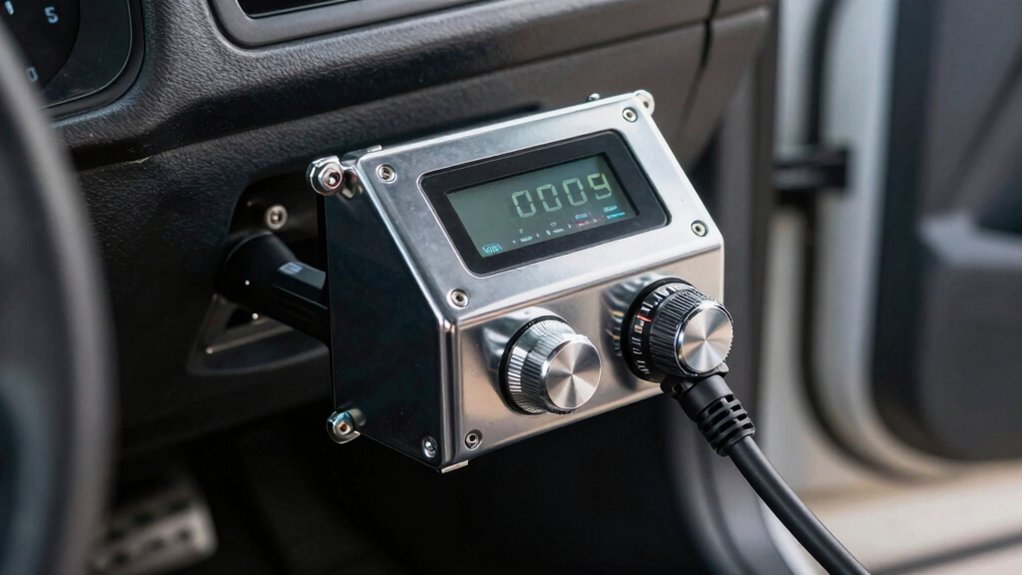
You’ll need a trailer brake controller if your trailer’s gross vehicle weight rating exceeds your state’s threshold—typically 3,000 pounds, though some states mandate them at 2,000 pounds or lower. Without one, you’re risking trailer push or jackknifing during braking, which creates dangerous loss of vehicle control. Electric brakes specifically can’t function without a properly installed controller. State requirements vary considerably, and understanding your jurisdiction’s standards guarantees you’re properly equipped for safe towing.
Do You Actually Need a Trailer Brake Controller?
Whether you need a trailer brake controller depends primarily on your trailer’s gross vehicle weight rating (GVWR) and your state’s legal requirements. Most states mandate trailer brakes for units exceeding 3,000 lb GVWR, though Kansas requires them at 2,000 lb, while Nevada and California enforce them at 1,500 lb. Texas provides exemptions for trailers under 4,500 lb GVWR or those between 4,500-15,000 lb traveling below 30 mph.
Understanding basic trailer braking requirements ensures compliance with your jurisdiction’s standards. A controller becomes essential for proper trailer setup procedures, as it synchronizes your trailer’s brakes with your tow vehicle’s deceleration. This coordination prevents dangerous conditions like trailer push or jackknifing during heavy braking, particularly vital when hauling substantial loads or navigating downhill terrain. Advanced controllers may feature three-axis accelerometers that provide enhanced control in various driving conditions. Electric trailer brakes do not function without a properly installed and calibrated brake controller to regulate their operation. Proper gain setting adjustments ensure your trailer brakes respond appropriately to your vehicle’s deceleration without causing wheel lock-up or insufficient stopping power. The controller’s blue wire connection to your trailer’s brake magnets completes the electrical circuit necessary for brake activation.
Electric vs. Surge Brakes: Which Requires a Controller?
Now that you’ve determined whether your trailer requires brakes based on weight and state regulations, you’ll need to choose between two distinct braking systems: electric and surge brakes.
Electric brakes demand a brake controller installed in your tow vehicle. This controller sends electrical signals to activate trailer brakes when you apply pressure to your vehicle’s pedal, offering proportional force adjustment and independent control capabilities. Guaranteeing trailer brake requirements guarantees you meet legal compliance standards. Modern brake controllers like the REDARC Tow-Pro Elite feature smooth proportional braking with immediate response for enhanced towing safety.
Surge brakes operate independently without any controller or electrical connection. A hydraulic mechanism activates automatically when your trailer’s momentum pushes against the hitch during deceleration. This self-contained system requires no wiring or driver intervention. Electric brake controllers offer faster response times compared to surge brake systems, providing greater control during emergency stops. The water-resistant design makes surge brakes particularly suitable for boat trailers that are frequently exposed to moisture and corrosive environments. For vehicle-specific applications, some vehicles like certain Toyota 4Runners may require aftermarket solutions if they lack factory harnesses.
The importance of compliance means selecting the appropriate system for your application. Electric brakes suit heavy-duty hauling requiring precise control, while surge brakes work well for boat trailers exposed to water.
Brake Controller Laws by Trailer Weight and State
Most states establish brake requirements based on your trailer’s gross vehicle weight rating (GVWR), though these thresholds vary considerably across jurisdictions. You’ll find five distinct categories: 1,500 lbs (California, Idaho, Nevada, New Hampshire, Oregon), 2,000 lbs (Kansas, Ohio), 3,000 lbs (36 states including Alabama and Florida), 4,000 lbs (Delaware, North Carolina, Rhode Island), and higher thresholds like Texas’s 4,500 lbs or Alaska’s 5,000 lbs.
Understanding your state’s specific requirements directly impacts your trailer maintenance requirements and towing safety considerations. Some states impose additional mandates—New Jersey requires synchronized breakaway brakes, while Wyoming and Kansas demand 40-foot stopping distances from 20 mph. Missouri uniquely exempts fifth wheels from its 10,000 lbs threshold. Matching your receiver tube size to your trailer’s weight capacity helps ensure your braking system operates effectively. Proper hitch receiver compatibility between your towing vehicle and trailer ensures safe operation across different weight classes. Regular maintenance like addressing receiver hitch rattle through anti-rattle devices or hitch tightener clamps can improve overall towing stability and safety. Most newly manufactured towable campers include trailer braking systems regardless of size, making compliance easier for modern RV owners. Verify your state’s regulations before purchasing brake equipment to guarantee compliance and safe operation.
What Happens Without a Controller: Real-World Consequences
Operating a trailer without a brake controller transforms your tow vehicle into the sole braking mechanism for a combined weight that often exceeds 10,000 pounds. Your truck’s brakes handle the entire load alone, causing rapid overheating and prolonged brake wear that accelerates component degradation. Extended stopping distances become inevitable as trailer momentum pushes against your vehicle, demanding greater distances for complete stops—a risk magnified on ice-covered roads.
The trailer continues its forward momentum independent of your braking efforts, increasing jackknifing risks and trailer sway. This instability demands manual intervention you shouldn’t need. Additionally, your engine works harder compensating for inadequate braking, resulting in decreased fuel efficiency. A proportional brake controller synchronizes your trailer’s braking with your truck’s system for balanced stopping power. Meanwhile, you’re violating state regulations mandating controllers for trailers over 1,500 pounds, inviting traffic citations and exposing yourself to liability during accidents.
Time-Delay vs. Proportional Controllers
Time-delay controllers apply preset power after a fixed interval, regardless of your actual braking intensity. They’re budget-friendly and installation-simple, but they can’t match your vehicle’s deceleration precisely.
Proportional controllers use accelerometers to sense your deceleration rate and modulate trailer braking accordingly. This real-time adjustment delivers smoother stops and superior emergency braking performance when you need maximum stopping power. Federal law requires trailers with a loaded weight exceeding 3,000 pounds to have a braking system, making the choice between controller types essential for compliance and safety. Models like the Tekonsha Primus IQ feature digital readouts and adjustable brake boost levels for enhanced control and error detection.
The brake wear reduction benefit heavily favors proportional systems. By matching trailer and tow vehicle braking forces, proportional controllers prevent the jerky, uneven wear that time-delay models can cause. Proportional controllers are particularly valuable for light recreational towing through heavy-duty commercial applications. Trusted brands like Tekonsha, Redarc, and Curt dominate the market due to their easy installation and digital diagnostics capabilities.
For highway driving and demanding conditions, proportional technology provides the control and safety proportional to your investment.
When Controllers Are Legally Mandatory
Whether you’re required to install a brake controller depends on federal regulations and your state’s specific threshold requirements. If your trailer’s GVWR meets or exceeds your state’s braking threshold—typically ranging from 1,500 to 10,000 pounds—you’ll need a controller for electric brakes. Federal law mandates controllers for electric systems at 4,000 pounds or more when loads require modulation.
Your controller must operate all service brakes through a single hand or foot device. This guarantees consistency and eliminates contrast in braking capability between tow vehicle and trailer. Additionally, verify compatibility with suspension type, as surge brakes remain exempt from separate controller requirements due to their self-contained design. Proportional controllers use internal accelerometers to detect deceleration and automatically apply matching braking force, offering superior safety for compliance with federal standards. To ensure safe towing, you should adjust the gain setting to achieve proper braking balance between your trailer and tow vehicle. Proper adjustment of brake controller gain settings ensures your trailer and tow vehicle stop together without the trailer pulling back on the vehicle. Trailers equipped with hydraulic axle brakes controlled by an electric brake controller must comply with applicable NHTSA hydraulic brake standards. Check your specific state’s regulations, as reciprocity isn’t universal across all jurisdictions.
Choosing the Right Controller for Your Setup
Now that you understand when you’re legally required to install a brake controller, you’ll need to select the specific type that matches your towing situation. Evaluate your towing frequency first—proportional controllers suit regular hauling through superior braking modulation, while time-delayed units work for occasional use. Consider your trailer’s axle count and weight capacity to guarantee compatibility. Examine integrated installation options: dash-mounted controllers offer direct vehicle integration, whereas trailer-mounted systems provide flexibility without modification. Wireless connectivity features streamline setup, particularly models with Bluetooth enablement across multiple vehicles. For vehicles without integrated controllers, wireless solutions like the Tekonsha and Prodigy RF systems eliminate the need for complex wiring modifications while providing proportional braking and diagnostics. The Echo® series balances state-of-the-art technology and reliability, making it ideal for all users from fleet managers to casual drivers. Popular wireless options like the Curt Echo offer plug-and-play installation with real-time monitoring capabilities. When evaluating your options, review user reviews and ratings to understand real-world performance across different towing scenarios. Factor in budget constraints, vehicle compatibility, and terrain use. Finally, verify your system’s voltage requirements—12V or 24V—and confirm compliance with relevant standards for your jurisdiction.
Does Your Trailer Already Have a Brake Controller?
Before you purchase and install a vehicle-mounted brake controller, you’ll need to determine whether your trailer’s equipped with electric brakes that’ll actually work with one.
Start by inspecting your trailer’s wheel hubs and brake drums for electrical connectors. Trailer brake component identification requires examining the axles for brake magnets or actuators—these indicate electric brake presence. Check your trailer’s documentation or manufacturer specifications for details on your trailer brake system operation.
Look underneath the trailer for wiring harnesses running along the frame toward the tongue connector. Verify that your trailer’s existing brake wiring matches your vehicle’s connector type. You can test your trailer’s brake system by using a circuit tester to verify proper output on the brake controller. When selecting a testing device, consider the key features of trailer testers to ensure accurate diagnostics of your electrical connections. A trailer brake controller activates and releases the electric brakes on your trailer to ensure synchronized braking with your towing vehicle. If you’re uncertain about your specific trailer’s capabilities, consult the manufacturer directly or have a qualified technician perform an inspection to confirm compatibility before proceeding with controller installation.