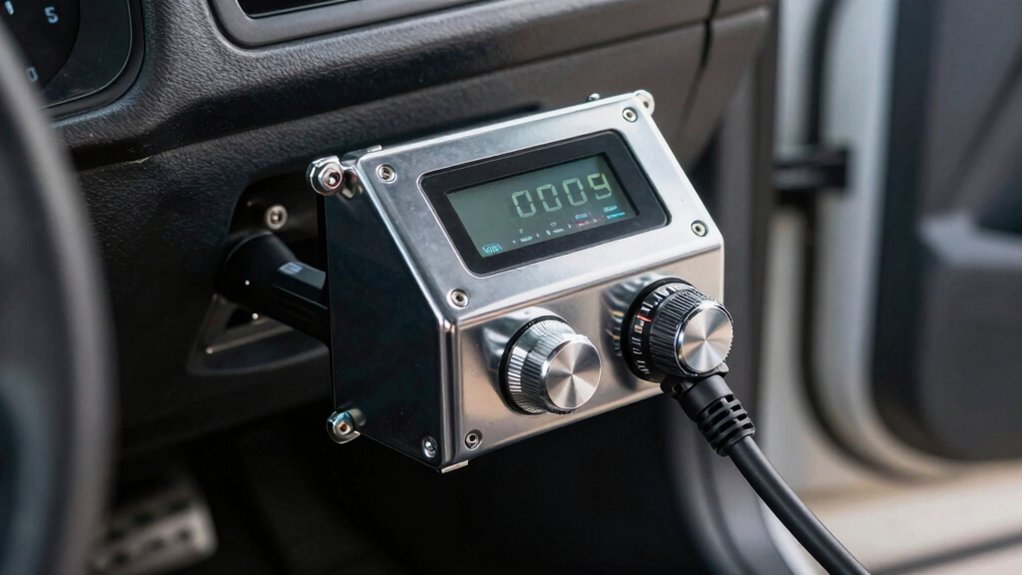
You’ll route your trailer brake controller‘s power wire through your vehicle’s fuse panel, ground it to clean bare metal on the chassis, and splice signal wires into your brake light switch and turn signals. Use 12-gauge minimum wire for all connections and verify 12.5 volts at the brake pin when engaging brakes. Start calibration at 20-25 mph in traffic-free areas, adjusting settings until you achieve ideal braking without wheel lock-up. Test both manual control and brake pedal integration to guarantee proportional synchronization between your towing vehicle and trailer.
Identify Your Vehicle’s Axle Count and Brake Setup
Before you install a trailer brake controller, you’ll need to determine your vehicle’s axle configuration and existing brake system type. Vehicle axle type detection starts by counting your vehicle’s axles and identifying their arrangement—whether you have single or dual tires. This information directly impacts trailer brake system calibration settings.
Inspect your vehicle’s differential cover to count bolt patterns, which correlate to axle types. Document your axle spacing and verify whether you’re running tandem or single axle configurations. Check your current brake system specifications, including whether you have hydraulic or electric brakes. The hitch receiver that connects your trailer to your vehicle should also be inspected to ensure it’s properly mounted to your vehicle’s frame before installing brake control systems. Testing your vehicle’s electrical system with a multimeter or circuit tester will help you verify proper voltage delivery to the brake controller before final installation. Matching your hitch class to your vehicle’s towing capacity ensures the brake controller will function safely with your trailer’s weight.
You’ll also need to identify raised axles on trucks, which require different detection methods than standard ground-contact wheels. Advanced detection systems use tire-based tracking algorithms to accurately count axles on long vehicles where partial occlusions may obscure the complete axle configuration. Understanding these details guarantees proper controller programming and ideal braking performance when towing.
Choose and Connect Your Power and Ground Wires
Once you’ve determined your vehicle’s axle configuration, you’ll need to select the appropriate power and ground wires based on your specific towing setup. For 1-2 axle trailers, use 14-gauge minimum wire with a 20-amp fuse. For 3-4 axle applications, use 12-gauge wire and install a 30-amp circuit breaker. Connect your power wire to the positive battery terminal, routing it through your firewall to the auxiliary fuse panel. For correct wire gauge selection, remember that 10-gauge handles heavier loads more efficiently than 12-gauge by reducing voltage drop. Your white ground wire connects to clean bare metal on the chassis or battery negative terminal. Proper ground resistance requires secure connections at unpainted surfaces to guarantee reliable braking performance and prevent intermittent failures. Many vehicle owners choose factory-style wiring harnesses like the Tekonsha custom-fit option to simplify the installation process and ensure compatibility with their specific vehicle model. Consider adjusting gain settings during initial setup to optimize braking response for your trailer configuration. Locate the 12V brake light switch feed wire to establish your brake signal connection before finalizing the circuit.
Route All Signal Wires to Brake Activation Points
With your power and ground circuits properly established, you’ll now route the signal wires that communicate braking commands from your vehicle to the trailer.
You’ll splice into the red brake wire on the cold side of your brake light switch, where voltage reads 0V at rest and 12V when braking. Test this splice point to confirm correct positioning. Next, locate your turn signal wires—typically accessed under the hood or dash—routing left and right signals to your controller or 7-way connector.
Run your blue output wire from the controller along the vehicle’s frame, using secure wiring paths with loom protection. Keep signal wires away from the radio antenna and power lines to minimize electromagnetic interference. For custom installations lacking factory harnesses, consider routing wires from the fuse box and battery with circuit breakers for added protection. To further reduce vibration and noise during towing, consider pairing your installation with anti-rattle hitch pins to ensure stable trailer connections. Bundle everything carefully, preventing chafing against moving components. Verify all connections reach their designated pins with proper voltage readings. Ensure your receiver hitch clamp is properly secured before testing brake signal transmission. Use 12-gauge stranded wire for all signal connections to ensure reliable brake signal transmission between your vehicle and trailer.
Ground Your Controller to Prevent Signal Loss
A proper ground connection is essential to your brake controller’s performance, as poor grounding creates electrical faults that’ll compromise braking consistency and reliability. You should connect your ground wire directly to clean, bare metal on the battery or chassis frame—scraping away paint and corrosion guarantees solid conductivity. Use 10-gauge wire matched end-to-end for maximum current capacity.
To monitor ground integrity, measure resistance between the ground pin and attachment point with a multimeter, targeting below 2 ohms. Test continuity from truck contact points to the frame. Verify 12.5 volts at the brake pin when brakes engage. Proportional controllers are more responsive than time-delay models and will benefit significantly from precise ground connections that ensure consistent voltage delivery to the trailer brakes. Understanding brake controller compatibility with your specific vehicle and trailer combination helps guarantee optimal performance across different towing scenarios. Most advanced controllers feature additional safety mechanisms such as manual activation buttons that allow independent trailer brake application when needed. If your trailer uses electric brakes, your brake controller must maintain a strong ground connection to reliably intermediate between your vehicle and the trailer’s braking system.
When you troubleshoot ground failures, inspect connections for looseness and verify snug attachment after installation. Reattach to the battery if chassis grounding proves inadequate, eliminating signal loss and preventing brake system malfunctions.
Verify Brake Activation on Test Drives
You’ve completed the electrical groundwork—now it’s time to verify that your brake controller actually engages the trailer brakes when you need them to. Start your initial calibration process at 20-25 mph in a traffic-free area. Squeeze the manual control lever completely to engage trailer brakes independently of your vehicle’s system. Monitor wheel lock-up behavior—squealing tires indicate excessive braking force, requiring a GAIN reduction. If wheels turn freely, increase the setting. Repeat acceleration and braking cycles until you reach the threshold just below lock-up. Next, test brake pedal integration by pressing your vehicle’s brake pedal and observing instantaneous trailer brake response. Proportional controllers provide superior smoothness compared to time-delayed alternatives, especially when performing test drives with varying vehicle speeds. Performing a slow-speed stop test will help you assess brake bias and smoothness of operation throughout different stopping scenarios. For more precise diagnostics during initial setup, you can use a circuit tester to verify brake output activation before conducting full test drives. Most RAM 1500 models feature an integrated controller accessed below the in-dash touchscreen that allows you to adjust automatic gain settings for optimal braking performance. This real world driving conditions verification confirms your installation functions properly before highway use.