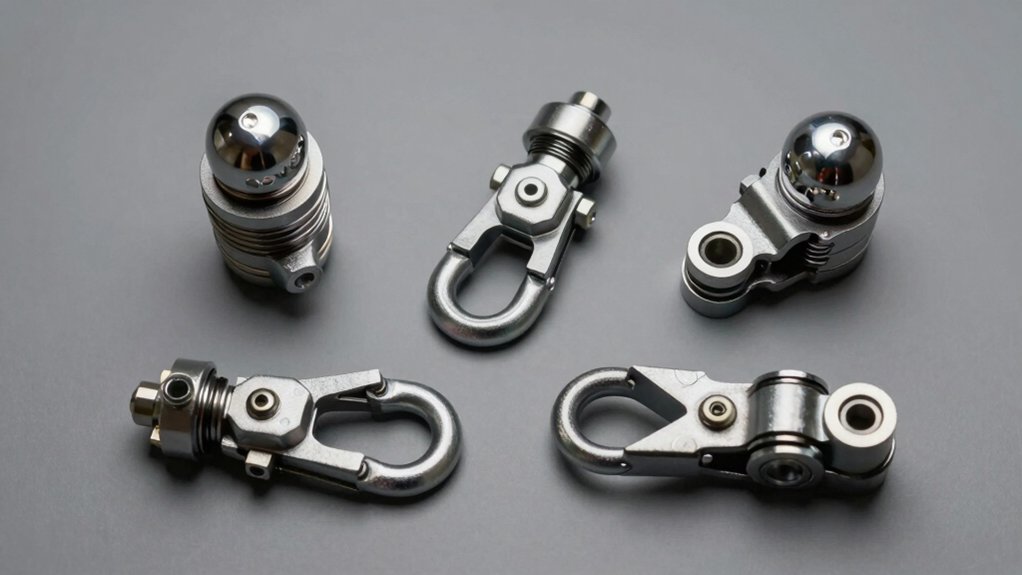
You’ll find three standard hitch ball sizes that match specific weight capacities. The 1-7/8-inch ball handles light-duty loads up to 3,500 lbs, while the 2-inch ball supports 3,500–8,000 lbs and offers versatility for most applications. The 2-5/16-inch ball provides heavy-duty capacity from 10,000–30,000 lbs. You must match your coupler’s stamped size to your ball diameter and verify your trailer’s GVWR before selecting equipment. Mismatched components create serious safety risks that warrant deeper exploration.
Understanding the Three Standard Ball Sizes
When you’re selecting a hitch ball, you’ll find that three sizes dominate the market, each designed for specific towing capacities and vehicle classes. The 1-7/8-inch ball handles light-duty applications up to 3,500 lbs, making it ideal for compact utility trailers. The 2-inch ball represents the most versatile option, supporting 3,500–8,000 lbs across Class 3 receiver hitches and accommodating standard U-Haul rentals. The 2-5/16-inch ball provides heavy-duty capacity, ranging from 10,000–30,000 lbs depending on shank diameter, essential for dump trailers and tandem axle haulers.
You’ll encounter common hitch ball upgrades when evaluating your towing needs, and proper hitch ball maintenance—including regular inspections and secure fastening—ensures system reliability and longevity regardless of which size you choose. Ball mounts come in fixed, adjustable, and offset types to accommodate varying trailer heights and towing configurations. The receiver tube size of your vehicle’s hitch receiver must match the shank diameter of your selected ball to ensure proper fit and safety. Matching the ball size precisely to your trailer’s coupler is critical for safety, as an improper fit can cause dangerous issues like swaying, bouncing, or detachment while driving. A solid connection between the ball and coupler prevents the hitch ball from loosening during transport and maintains safe towing performance.
Match Your Coupler to the Right Ball Size
Your trailer’s coupler is the critical intermediary between ball and trailer, and it won’t function safely unless you’ve verified it precisely to your hitch ball. Start your proper coupler inspection by locating the manufacturer’s stamped size on the coupler’s top surface. If you can’t find markings, measure the inside opening diameter using a tape measure or ruler. You’ll typically find sizes of 1-7/8″, 2″, 2-5/16″, or 3″. Next, perform coupler height confirmation by measuring the distance from ground to coupler opening when your trailer sits level. This corroborates proper alignment with your ball mount. Finally, match these measurements exactly to your hitch ball specifications. No approximations work—mismatched sizes create dangerous swaying and detachment risks during towing. Remember that each ball hitch size is engineered for specific trailer types and weight classes, so selecting the correct size prevents catastrophic failures under stress. Different ball sizes handle varying load capacities, from 2,000 pounds for smaller balls to over 10,000 pounds for larger options, making proper selection essential for safe towing. The 2″ ball represents the most versatile choice for medium-duty applications across diverse trailer types. Top hitch ball options like the Reese Towpower Tri-Ball provide reliable performance with powder-coated finishes that enhance durability against rust and corrosion.
1-7/8-Inch Balls for Light Trailers and Tow Vehicles
The 1-7/8-inch hitch ball represents the smallest standard size in common use, engineered specifically for light-duty towing applications where gross trailer weight doesn’t exceed 3,500 lbs. You’ll find this size matches exclusively with 1-7/8-inch couplers on light trailers, utility units, and small boat haulers.
For lightweight towing safety, you must validate the ball size stamped on top before installation. Proper ball installation requires torquing the nut between 160 and 250 ft-lbs using a 1-1/8 inch socket, with the lock washer secured beforehand. The shank diameter ranges from 3/4 to 1 inch, accommodating drawbar thicknesses of 0.375 to 0.625 inches. Hot-forged steel with chrome plating guarantees corrosion resistance. The zinc-plated hex nut provides enhanced durability and secure fastening for long-term reliability. Regular lubrication of the hitch ball prevents premature coupler wear and maintains a safe connection during towing. This configuration suits weekend excursions with minimal loads, personal watercraft, and Class 1 hitch-compatible trailers. Selecting the correct pin diameter and length ensures compatibility with your specific hitch receiver and prevents safety hazards during towing. Popular options like the CURT model deliver reliable performance with extra-long shanks ideal for bumper towing on various vehicles.
2-Inch Balls: The Universal Choice for Medium-Duty Towing
Because most recreational and light commercial towing applications demand reliable versatility, the 2-inch hitch ball has become the industry standard across North America. You’ll find this ball size rated for gross trailer weights up to 8,000–12,000 pounds, depending on your hitch class and configuration.
The 2-inch ball pairs with receiver hitches in Class III through V applications, accommodating various shank diameters and lengths. You’ll achieve secure installation by matching the ball’s shank thickness to your ball mount’s specifications. The chrome-plated steel construction resists corrosion in extreme weather, while the 450 foot-pound torque specification certifies proper tightening. Precise fit between the ball diameter and the trailer’s coupler is essential to ensure secure trailer attachment and prevent disconnection during transport.
You’ll install the ball with a 5/8-inch hitch pin and locking washer, meeting or exceeding SAE J684 standards. The hitch pin or hitch lock prevents the ball mount from sliding out of the receiver tube during towing. For optimal safety, always verify that your ball capacity matches the lowest-rated component in your complete towing system. This universal choice suits your small boats, campers, and single-vehicle trailers effectively.
2-5/16-Inch Balls for Heavy RVs and Large Trailers
Most heavy-duty towing applications—including large RVs, multi-car trailers, and commercial equipment haulers—demand the 2-5/16-inch hitch ball, which you’ll recognize by its larger diameter and substantially increased weight capacity. You’ll find these balls rated between 14,000 and 30,000 pounds, far exceeding smaller alternatives that max out at 12,000 pounds.
The heavy duty construction employs high strength steel, often heat-hardened, ensuring durability under extreme stress. You must match the ball precisely to your trailer’s coupler—a mismatch risks instability or failure. You’ll typically torque these balls to 450 foot-pounds using a lock washer and nut. The 1-1/4 inch shank diameter provides structural integrity for secure fastening to your vehicle’s drawbar. Top-rated options like the REESE Towpower 7068820 feature powder-coated and chrome-plated finishes for enhanced rust resistance.
You should verify your trailer’s GVWR, tongue weight, and hitch class before selecting equipment. Understanding the weight capacity ratings specific to your hitch and trailer combination ensures you stay within safe towing limits. For users needing multiple ball sizes, adjustable multi-ball systems offer flexibility for different towing scenarios without purchasing separate hitches. Chrome or stainless finishes resist corrosion in demanding conditions, protecting your investment and ensuring safe operation throughout heavy towing seasons.
Ball Size, Shank Diameter, and Mount Compatibility
While selecting the right ball diameter solves half the compatibility puzzle, you’ll also need to match the shank diameter and mount class to complete a safe towing system. Your shank diameter must correspond to the receiver hole size, coming in 5/8″, 3/4″, 1″, or 1-1/4″ options, each rated for different weight capacities up to 17,000 lbs.
Ball mount class determines your hitch receiver compatibility. Class I and II accommodate 1.25-inch mounts for trailers under 3,500 lbs, while Class III and IV use 2-inch mounts supporting up to 10,000 lbs. Class V hitches fit 2.5-inch mounts rated for 17,000 lbs capacity. Using a weight distribution hitch can help distribute trailer weight more evenly across your vehicle.
Consider weight distribution requirements when selecting heavier applications. Locking ball mounts provide security, preventing unwanted movement between shank and mount. For maximum stability with large trailers, gooseneck and fifth-wheel hitches offer superior load management compared to standard receiver configurations. Precise component matching guarantees proper load distribution and eliminates dangerous swaying or bouncing during towing.
Safety Risks of Mismatched Hitch Components
Mismatched vehicle tow ratings create dangerous instability and excessive wear. When you use a 2-5/16″ ball with a 2″ coupler, the coupler pops off during transit. Underrated hitch components fail catastrophically—insert shearing causes mid-drive separation, while loose couplers detach without warning. Always consult your vehicle’s manual to verify the maximum towing weight your vehicle can safely handle.
You’ll experience trailer sway when hitch capacity doesn’t match load weight. Friction hitch slippage under load causes uncontrolled movement at highway speeds. Fatigue loading fractures A-frame drawbars and eye bolts, compromising structural integrity. Matching your hitch class to your vehicle’s towing capacity rating ensures safe operation and prevents catastrophic failures. Different receiver sizes like 1-1/4 inch for lower classes and 2-inch for higher classes accommodate varying weight capacities. Each hitch class has specific weight limits, ranging from Class 1 at up to 2,000 lbs to Class 5 at up to 20,000 lbs.
Improperly secured couplings result in kingpin uncoupling at the turntable. Poor weight distribution heightens instability on inclines and increases braking distance. These mismatches void warranties and substantially elevate accident risk on public roads.