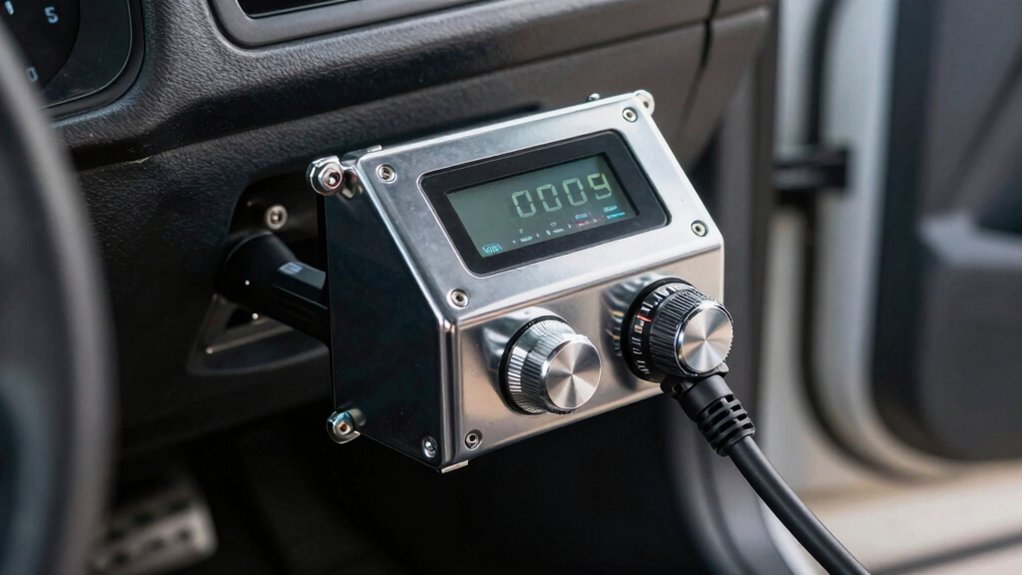
You’ve got three main trailer brake controller types to choose from. Time-delay controllers build braking force progressively over a fixed duration—ideal for occasional towing but prone to jerky stops. Proportional controllers use accelerometers to match your vehicle’s deceleration, delivering smooth, adaptive braking perfect for frequent hauling. Combination controllers offer both modes, switching between them for versatility across varying conditions. Each transmits voltage through your 7-way connector to activate trailer electromagnets. The right choice depends on your towing frequency, load size, and performance needs.
Time-Delay Controllers: Fixed-Rate Braking for Basic Towing
When you press your tow vehicle’s brake pedal, a time-delay controller activates your trailer’s brakes with a preset intensity that builds progressively over a fixed duration—typically around three seconds. You’ll experience a delay between your braking application and full trailer engagement as the system ramps up to maximum power based on your gain settings.
Time-delay controllers offer notable installation ease since they don’t require leveling or complex setup procedures. You can adjust the initial braking power, sync timing, and threshold voltage before hauling, accommodating varying trailer loads. During drives, you’re able to modify brake force on the fly, giving you user adjustability for different conditions. These controllers are commonly used for lighter, occasional towing applications where precision braking is less critical than cost-effectiveness. Time-delay controllers are suitable for lighter towing situations and represent a more affordable option compared to proportional controllers, which provide more advanced functionality for heavier loads. Most time-delay systems include manual override sliders that allow real-time brake force adjustments during your tow.
However, this fixed-power approach produces jerky stops and push-pull dynamics. The controller doesn’t differentiate between gentle braking and panic stops, making it less smooth than proportional alternatives. Unlike proportional controllers that match the trailer’s braking force to the vehicle’s braking force, time-delay models apply power on a fixed increasing scale regardless of how hard you’re actually braking.
Proportional Controllers: Sensor-Based Braking That Matches Your Speed
While time-delay controllers apply braking force on a fixed schedule regardless of how hard you’re actually slowing down, proportional controllers take a fundamentally different approach by using an accelerometer to detect your vehicle’s deceleration and match your trailer’s braking intensity to that precise rate. This sensor continuously monitors momentum changes, translating physical forces into electrical signals that proportionally adjust braking power. Your setup applies less force when towing uphill or with light loads, and increases output downhill or with heavy cargo. Proper accelerometer calibration guarantees accurate function, while ideal weight distribution across your trailer enhances sensor responsiveness. The result: smooth, adaptive braking that reduces wear on all components and delivers natural-feeling stops in varying conditions. Popular models like the Tekonsha Primus IQ excel at terrain-adaptive performance, automatically adjusting to highway or city towing conditions. Proportional controllers provide more precise braking adjustments compared to time-delay methods, ensuring efficient stopping power tailored to your specific towing situation. These systems work seamlessly across different trailer types, making them a versatile choice for various towing applications.
Combination Controllers: Flexibility Between Timed and Proportional Modes
What if you could harness the best aspects of both proportional and timed braking systems without compromising on performance?
Combination controllers deliver exactly that versatility. You’ll switch between proportional mode—which uses inertia sensors to match your trailer’s braking to your tow vehicle’s deceleration—and timed mode, which applies brakes at a fixed rate regardless of deceleration intensity.
This dual functionality accommodates your operator customization preferences across varying road conditions and vehicle loads. In proportional mode, you’ll experience smooth braking interchange that feels natural during highway driving. Timed mode offers predictable, leading brake application when you need it. Many combination controllers feature plug-and-play wireless options for easier installation compared to traditional hardwired setups, with models like the Curt Echo offering Bluetooth connectivity for smartphone control.
You’ll adjust gain settings to match your trailer’s specific load requirements. Proportional controllers use an accelerometer sensor to detect inertia and translate physical forces into electrical signals for precise braking adjustments. While combination controllers cost more than single-mode units, they eliminate the need for multiple devices, reducing brake and tire wear while enhancing safety across diverse towing scenarios.
How Your Brake Controller Sends Signals to Your Trailer
Whether you’ve selected a combination controller or a single-mode unit, understanding the signal pathway from controller to trailer brakes guarantees you’ll maintain ideal stopping performance. Your controller transmits voltage through the blue wire in your 7-way connector, energized by your vehicle’s battery. This signal travels to trailer brake assemblies, where electromagnets activate proportionally based on deceleration detection or timer sequences. Brake signal integrity depends critically on controller installation considerations—secure connections under your dash and hood prevent voltage drops that compromise braking force. You can verify signal consistency using a multimeter at the controller output. The electromagnet’s strength directly correlates to shoe pressure against drums, making proper wiring essential for reliable trailer braking across varying load conditions. Minimum wire gauge requirements of 12-14 gauge stranded wire ensure adequate current delivery without excessive voltage loss during braking events. Proportional controllers deliver superior smoothness and safety compared to time-delayed alternatives, especially during frequent or heavy towing. For proportional controllers specifically, the gain adjustment setting allows you to fine-tune how much braking force is applied relative to your vehicle’s deceleration rate. Electric brake controllers offer faster response times and easier installation compared to hydraulic systems, making them increasingly popular for modern towing applications.
Which Controller Should You Choose for Your Rig?
Selecting the right trailer brake controller hinges on three critical variables: your trailer’s weight, your towing frequency, and your vehicle’s braking system architecture. For trailer weight classes, proportional controllers excel with heavy loads, adapting braking force proportionally to deceleration. Time-delayed units suit lighter occasional use but risk jerky stops under substantial weight. Regarding towing frequency analysis, frequent haulers benefit from proportional systems’ automatic emergency sensing and reduced brake wear. Occasional towers find time-delayed controllers‘ affordability and adjustable ramp-up times sufficient. Match gain settings to your load size for ideal performance. The REDARC Tow-Pro Elite offers smooth proportional braking that eliminates jerky stops through its dash-mounted knob design. Consider plug-and-play models like CURT Echo Mobile for simplicity, or integrated systems like Tekonsha Primus IQ for advanced diagnostics and multi-axle support. Most modern integrated controllers, such as those found in 2023 RAM 1500 trucks, feature proportional controllers that apply trailer braking force matching the tow vehicle’s deceleration via accelerometers for enhanced safety. To ensure your controller functions properly, you can test the brake output wire by severing it near the controller and using a circuit tester to verify correct operation. Federal law mandates that RV trailers exceeding 3,000 pounds must have a braking system installed to ensure safe operation on public roads.