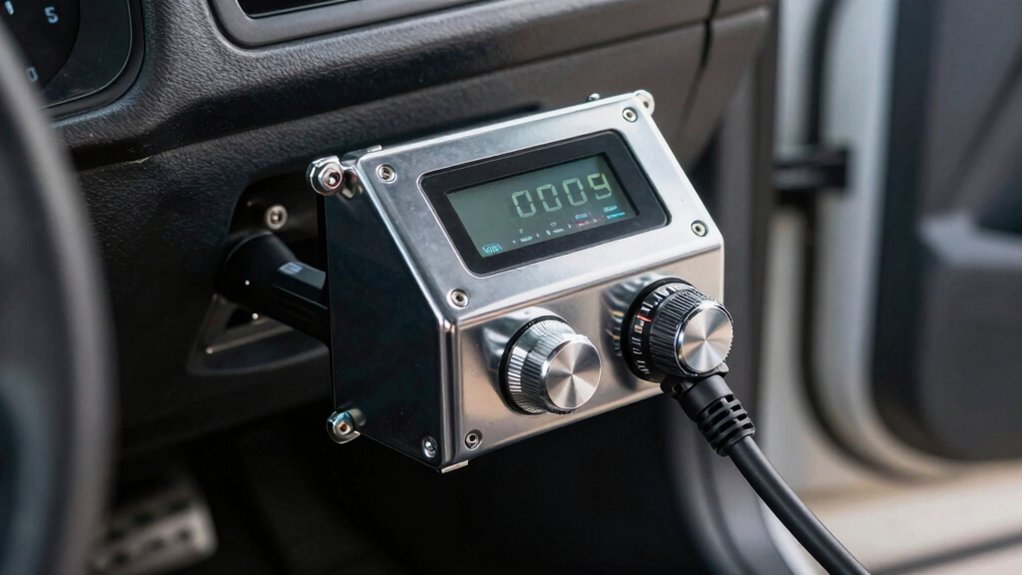
You can’t operate electric trailer brakes without a brake controller—they’ll remain completely inactive. The controller converts your tow vehicle’s braking signal into electrical current, enabling proportional engagement up to 12V. Without it, you’ll experience dangerously extended stopping distances and potential brake damage. Surge brakes function independently, but electric systems require this essential intermediary. You’ve got options: wireless controllers avoid dashboard drilling, while trailer-mounted units eliminate vehicle modifications entirely. Understanding which system suits your setup requires examining their distinct advantages.
Can Trailer Brakes Work Without a Brake Controller?
The answer depends entirely on your trailer’s brake type. If you’re operating surge brakes, you’ll find they function independently without any controller. Forward momentum pressing against the coupler’s actuator triggers hydraulic engagement automatically—no wiring or power source required. This makes surge brakes ideal for boat trailers in wet environments.
However, electric brakes limitations become apparent immediately without a controller. You can’t activate them through your tow vehicle’s 7-pin connector without a brake controller sending the necessary signal. Electric brakes remain completely inactive, leaving your trailer unbraked during stops. Your tow vehicle bears the entire braking load, increasing stopping distance dangerously. Proper brake controller setup requires adjusting gain settings to ensure responsive braking without wheel lock-up. For electric brake systems, you’ll need either a traditional dash-mounted controller or a wireless alternative to achieve proper braking function. Modern wireless options like the Curt Echo offer Bluetooth connectivity for smartphone control with plug-and-play installation. Wireless brake controllers like the Tekonsha Primus IQ provide proportional braking without requiring permanent vehicle wiring, offering user-friendly features and consistent performance for everyday towing needs.
Why Electric Brakes Fail Without a Controller
Without a brake controller, you’ve lost the critical intermediary that converts your tow vehicle’s braking signal into the electrical current your trailer’s brakes need to function. Your trailer’s electric brakes require precise voltage modulation—typically up to 12V—to engage proportionally with your vehicle’s deceleration. Without this conversion, you can’t apply graduated braking pressure, creating safety hazards and potential brake damage.
Improper controller settings or mismatched controller capacity exacerbate these failures. If your controller’s output doesn’t match your trailer’s magnet specifications, engagement becomes inconsistent or nonexistent. The magnet either receives insufficient current to activate or excessive current that causes burnout. Corroded connectors and other wiring issues can further compromise the electrical signal path between your vehicle and trailer brakes. Proper grounding and using 12-gauge wire minimum are essential to maintain reliable voltage delivery throughout the system. Advanced brake controllers may include three-axis accelerometers to provide enhanced control and more precise braking modulation in various driving conditions.
Additionally, you lack the protective circuitry controllers provide against electrical shorts and overloads. Many controllers feature plug-and-play designs that simplify installation and reduce wiring complications that could compromise system performance. Your trailer’s brakes become inoperable without this essential signal-conversion device managing power delivery.
Wireless Brake Controller Systems: No Dashboard Drilling
If you’re tired of drilling into your vehicle’s dashboard to install a brake controller, wireless systems offer a streamlined alternative that plugs directly into your existing 7-way connector. You’ll appreciate the flip-cap design that keeps dirt and debris out, while the locking tab guarantees a secure connection. The potted enclosure enhances water resistance, supporting your brake system maintenance without requiring vehicle modifications.
Wireless controller reliability means you maintain continuous brake monitoring through Bluetooth 4.0 technology, even during manual braking if the connection drops. You can transfer the portable unit between vehicles effortlessly. The multi-color LED indicator displays connection status in real-time, while the free app lets you adjust sensitivity, output, and brake programs directly from your smartphone—all without compromising functionality or safety. Unlike older non-proportional controllers, wireless systems measure vehicle dynamics to send precise voltage to trailer brakes that matches your tow vehicle’s deceleration. Proportional controllers use internal accelerometers or pendulum sensors to detect deceleration rate and automatically apply matching braking force to the trailer. These wireless solutions are compatible with different trailer types, making them adaptable for both recreational and commercial towing applications. For optimal performance, conduct brake tests at 40 km/h to fine-tune maximum output and sensitivity levels according to your specific towing setup.
Trailer-Mounted Controllers: No Vehicle Modifications
Mounting your brake controller directly onto the trailer eliminates the need for any vehicle modifications, allowing you to tow with virtually any vehicle regardless of its factory brake system capabilities. You’ll experience trailer mounted reliability since the self-contained system operates independently using inertia-sensing technology. The one-time installation on your trailer tongue requires no dashboard drilling, wiring modifications, or professional vehicle work. You achieve maintenance free operation through fully encased electronics that resist dust and water intrusion. The accelerometer continuously monitors deceleration dynamics, sending proportional voltage directly to your trailer brakes without in-cab controls. This approach preserves your tow vehicle’s factory warranty while enabling flexibility—you can switch between different vehicles without reconfiguration, maintaining consistent braking performance across all towing scenarios. Unlike electric brakes that require in-vehicle controllers, proportional controllers mounted on the trailer provide precise braking force adjustment based on deceleration. Trailer-mounted systems deliver faster response times compared to traditional in-vehicle solutions, ensuring your brakes engage with minimal delay. Trusted brands like Tekonsha and Redarc dominate the market due to their easy installation and digital diagnostics capabilities. Federal law requires trailers exceeding 3,000 pounds loaded weight to have a braking system, which this trailer-mounted solution fully satisfies.
Comparing Wireless vs. Trailer-Mounted: Which System Fits Your Vehicle?
How do you choose between a wireless brake controller and a trailer-mounted system? Evaluate your primary use case. If you’re towing with multiple vehicles, a trailer-mounted controller offers superior cost effectiveness by eliminating per-vehicle installations. You’ll gain on-the-fly adjustments via remote without dashboard access.
Conversely, wireless controllers suit single-vehicle owners prioritizing portability. Their real-time data monitoring through smartphone apps enables precise gain and sensitivity adjustments, though Bluetooth interference poses reliability concerns during emergencies. Trailer brake controllers are legally required in many jurisdictions when trailers exceed certain weight thresholds, making compliance an important factor in your decision.
Consider your fleet’s infrastructure. Trailer-mounted systems guarantee stable operation independent of vehicle electronics and remain compatible with any standard tow socket. These systems provide reliable braking power adjustment across different towing conditions and vehicle types. Wireless alternatives provide faster transfers between vehicles but demand consistent Bluetooth connectivity and introduce potential app-based delays during critical braking scenarios. Proper installation and maintenance practices ensure optimal braking performance across both controller types.
How to Install Your Brake Controller Without Major Wiring
Installing a brake controller needn’t involve extensive wiring modifications to your vehicle’s electrical system. If your vehicle has a factory tow package, you’ll find a direct plug-in port under the dash, eliminating splicing entirely. For tow package comparisons, pre-wired vehicles offer significant advantages in simplicity and braking performance enhancements.
Locate your port via the owner’s manual or online search. Mount the controller in accessible spots like your change pocket for convenience. When running wires for non-prewired vehicles, identify four essential wires: ground, power, brake light signal, and output. Route these down your frame using zip ties, tapping the brake switch wire under the dash or passenger footwell. Connect the blue wire to your trailer plug for brake output, securing all connections without major frame modifications. You can test your brake controller installation by severing the blue brake output wire and using a circuit tester to verify proper output on the controller side. Modern brake controllers like the Spectrum Integrated Proportional model feature a triple-axis accelerometer that enables responsive braking performance. The smooth proportional braking response of modern controllers reacts to your vehicle’s deceleration, improving overall stability during towing. Using proportional controllers like the Voyager XL provides a smooth braking response that reacts proportionally to your vehicle’s deceleration, improving overall stability during towing.
Manual Override and Emergency Braking Capabilities
While your brake controller’s automatic proportional braking handles most towing situations, you’ll find the manual override lever equally critical for maintaining precise control during challenging scenarios. You can activate trailer brakes independently from 0 to 10 scale, countering sway by slowing your trailer relative to your tow vehicle on steep descents.
For emergency stop maneuvers, the manual override serves as your failsafe during brake system failure or extreme sway conditions. You’ll achieve immediate trailer slowdown without engaging vehicle brakes. If the controller fails to recognize that your trailer is connected, the manual override remains fully functional as a backup braking system. Proper gain adjustment—typically 5-7 for standard loads—prevents wheel lockup during emergencies. Test your override at 25 mph in open areas, increasing gain settings only for heavier loads. The delay and gain functions work together to fine-tune braking response based on your specific towing conditions and load weight. The boost function controls the rate at which braking power is delivered to your trailer, allowing you to customize engagement speed for different scenarios. Ensure your ball mount and hitch components are properly secured before testing any braking systems, as loose connections can compromise safety during override activation. Never max out settings during crises; this risks losing traction control entirely.
Verify Your New Controller Works: Direct Battery Testing
After installing your new brake controller, you’ll want to verify its functionality through direct battery testing before relying on it during actual towing. Connect a fully-charged 12V battery directly to your trailer plug’s hot contact or individual brake assembly wires. Apply power and listen for a gentle humming sound from the brake magnets, indicating proper function. You should feel resistance when rotating the hub, confirming brake engagement. If you don’t hear humming or feel resistance, troubleshoot power connections by checking voltage with a test light. Do not use a battery charger for this test, as only a fully-charged 12V battery will provide the necessary power for accurate results. Next, inspect ground wiring carefully—examine both main trailer ground wires and individual brake grounds for loose or corroded connections. Guarantee all grounds connect to clean bare metal surfaces. This verification process prevents controller failures during towing operations.
Brake Controller Requirements by Trailer Weight and Legal Compliance
Your brake controller requirements depend on federal regulations and state-specific thresholds that you’ll need to verify before towing. Federal brake compliance mandates electric brake controllers for electronically actuated trailer brakes, though hydraulic surge brakes operate independently. Most states require brakes at 3,000 lbs GVWR, but state regulatory variations exist: California and Nevada require them at 1,500 lbs, Kansas at 2,000 lbs, and Delaware at 4,000 lbs. Trailers exceeding 6,500 lbs gross loaded weight require breakaway switches. Performance standards vary by weight class—combinations under 5,000 lbs GCW must stop within 30 feet at 20 mph, while those over 10,000 lbs need 50 feet. Non-commercial trailers under 26,000 pounds GVWR are not required to have ABS systems when using hydraulic brakes actuated by compressed air rather than driver control. Verify your specific state’s requirements before installation.
Troubleshooting Common Controller Issues Before Your First Tow
How can you confidently troubleshoot your brake controller before hitting the road? Start by verifying your power supply—check the fuse box for blown fuses and inspect wiring from the controller to the battery for loose connections. Measure incoming voltages on red and orange wires under load; you’ll need approximately 8V reaching the controller.
Next, examine ground connections for corrosion or looseness at the chassis. Test output voltage using your multimeter and confirm the duty cycle percentage changes when you tilt the controller. Repair any damaged wiring or terminals to restore proper power delivery to your brake system.
The importance of calibration can’t be overstated. Lower your gain setting gradually while testing at low speeds to prevent brake lockup. Finally, inspect brake shoes, magnets, and drums for wear. Ensuring proper installation by verifying all wiring connections per instructions prevents costly issues during your first tow.